
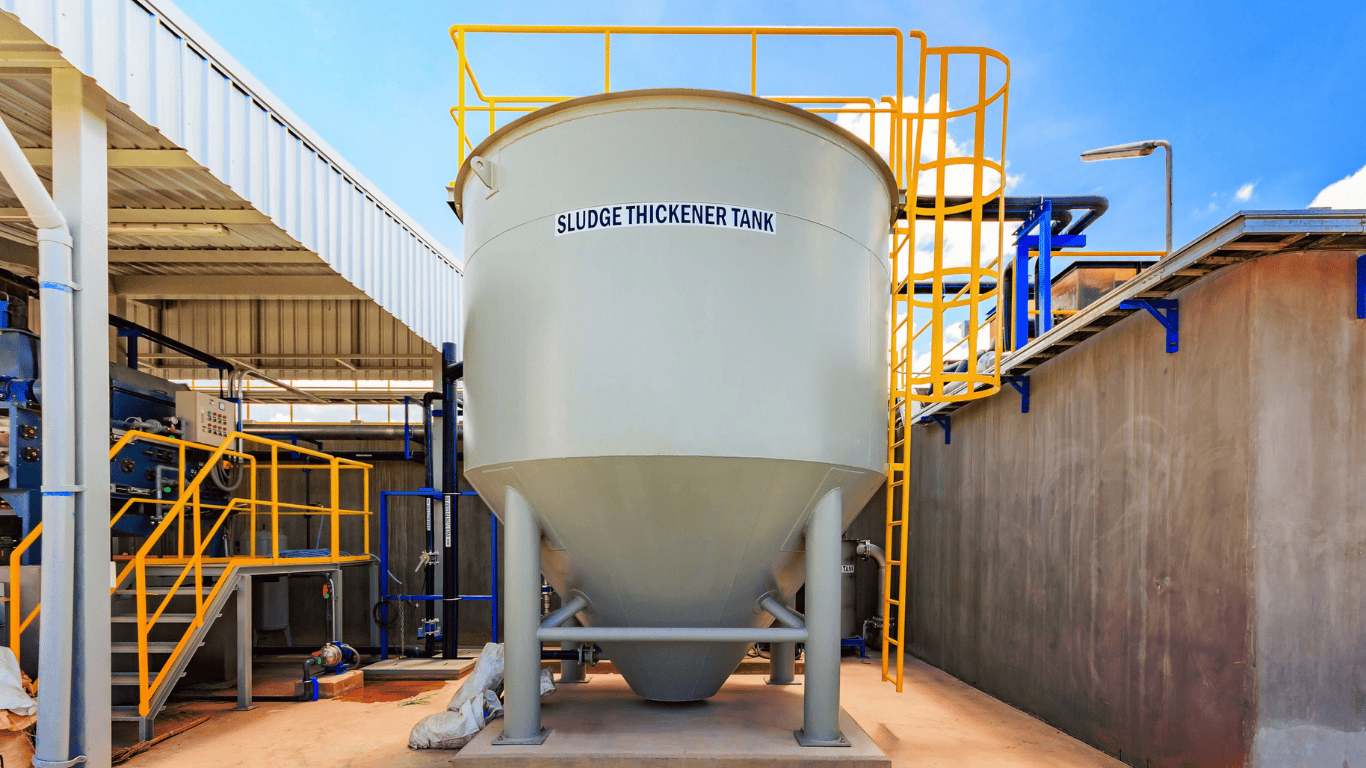
In industrial and municipal wastewater treatment, reducing sludge volume and moisture content is critical for disposal, reuse, or further processing.
ProChem Water provides engineered dewatering systems that combine sludge thickening, mechanical dewatering, and optional drying to minimize transport costs, simplify handling, and meet regulatory cake dryness requirements. Our solutions integrate equipment, automation, and lifecycle support to deliver predictable performance and operational efficiency.
Understanding Sludge Thickening vs Dewatering vs Drying
Effective sludge management starts with understanding the difference between thickening, dewatering, and drying. Sludge thickening concentrates sludge by removing a portion of free water, typically raising solids from 1 % to 4–6 %, while keeping it pumpable. Dewatering goes further, producing a cake with solids around 15–45 % by mechanically removing free and some interstitial water, often using centrifuges, belt presses, or screw presses. Sludge drying applies heat or evaporation after dewatering to achieve much drier solids, sometimes reaching 40–90 % dryness, reducing mass for disposal or reuse.
ProChem Water integrates these steps into a seamless system, optimizing performance from initial thickening to final drying to meet cake quality, disposal, or reuse goals while minimizing energy and chemical consumption.
Core Technologies & Equipment in Dewatering Systems
ProChem Water deploys a range of equipment to achieve optimal sludge thickening, dewatering, and drying:
- Centrifuges / Decanter Centrifuges – Use centrifugal force to separate solids from liquid. Compact and capable of continuous operation, they handle variable solids loads and feed directly into downstream drying or disposal processes.
- Belt Filter Presses – Compress sludge between filter cloths and rollers, achieving 12–25 % cake dryness. Known for reliability, continuous operation, and suitability for industrial applications.
- Screw Presses – Compact and robust, delivering moderate dryness with low energy consumption, ideal for certain sludge types.
- Filter Presses / Plate & Frame Filters – Produce high cake dryness (up to 40–50 %) using hydraulic pressure in batch operation, effective when very dry solids are required.
- Thermal & Contact Dryers – Further remove moisture after mechanical dewatering, including disc dryers, conductive or convective dryers, and vacuum systems, reaching 40–45 % or higher dryness.
- Hybrid & Integrated Systems – Combine thickening, mechanical dewatering, and optional drying to optimize performance, reduce footprint, and meet specific disposal or reuse goals.
Design Considerations & Best Practices
ProChem Water approaches dewatering system design with a detailed understanding of sludge characteristics, operational efficiency, and long-term reliability. Sludge analysis, including solids concentration, rheology, organic and fiber content, and seasonal variability, guides conditioning strategies such as polymer addition or pH adjustment to optimize dewatering. Pre-thickening upstream reduces the volume fed to dewatering units, lowering energy consumption and enhancing performance, while equipment selection balances throughput, cake dryness, footprint, and ease of operation.
Integration with conveyors, hoppers, and downstream handling ensures smooth material flow, while instrumentation and automation for torque, feed pressure, cake dryness, and alarms improves system monitoring and control. Maintenance access, safety, and environmental considerations, such as odor and dust control, are incorporated to ensure safe, predictable operation. These design principles create a cohesive, reliable system that delivers consistent results across varying sludge types and operational conditions.
Typical Applications & Use Cases
Dewatering systems are essential across a variety of sectors, helping reduce sludge volume, lower disposal costs, and produce manageable cake output:
- Municipal Wastewater: Efficiently handle sludge from primary, secondary, or tertiary treatment processes.
- Industrial Wastewater: Treat sludges from food and beverage, chemical, pulp & paper, or other manufacturing processes.
- Mining, Metals, and Mineral Processing: Manage tailings, slurries, and process residues.
- Agricultural / Livestock Waste: Dewater manure, digestate, and other organic waste for safer disposal or reuse.
- Oil & Gas / Petrochemical: Reduce volume and moisture of produced water sludge or process waste.
- Biosolids Handling: Prepare sludge for land application, incineration, or other disposal/reuse strategies.
These applications demonstrate the versatility of ProChem’s dewatering solutions, delivering consistent performance even under variable sludge types, volumes, and operational conditions.
Why ProChem Water Is Your Partner for Dewatering Solutions
ProChem delivers end-to-end expertise in sludge management, designing, integrating, and commissioning systems that combine thickening, dewatering, drying, control, and solids handling. Our modular, skid-mounted solutions simplify installation, reduce civil costs, and enable fast turnarounds, while pilot validation ensures optimal polymer dosing, feed concentration, equipment selection, and performance expectations.
Full lifecycle support, including spare parts, maintenance services, performance audits, tuning, and operator training, gives facilities confidence in throughput, cake dryness, solids recovery, and uptime. With ProChem, you gain predictable, reliable, and high-performance dewatering solutions that adapt to your operational needs over the long term.
Benefits & ROI
ProChem’s dewatering systems reduce sludge volume and moisture content, lowering transport, disposal, and landfill costs while improving cake handling and storage. Optimized designs minimize polymer and energy consumption, protect downstream operations from overloading, and provide a compact footprint for modular installations. Reliable performance ensures operational stability across varying flows and sludge characteristics.
These advantages translate into measurable financial benefits. Facilities gain faster ROI through reduced disposal expenses, lower maintenance needs, and more predictable sludge management. With ProChem’s full lifecycle support, including equipment, controls, service, and training, plants achieve cost efficiency, regulatory compliance, and long-term operational confidence.
Getting Started with ProChem’s Dewatering Solutions
- Share Facility Data – Provide sludge volume, solids concentration, site constraints, and desired cake dryness.
- Submit Samples – Supply representative sludge for characterization of total solids, volatile solids, particle size, and organics.
- Pilot or Bench Testing – Evaluate conditioning requirements, equipment performance, and cake quality under real-world conditions.
- Conceptual System Design & Proposal – Develop an integrated plan covering thickening, dewatering, drying, handling, control, and layout.
- Fabrication & Modular Assembly – Build mechanical units, control panels, piping, and structures with full factory QA.
- Installation & Commissioning – Perform on-site startup, calibration, control tuning, and operator training.
- Operations Support & Maintenance – Monitor performance, optimize polymer dosing, conduct audits, and provide ongoing support.
- Upgrades & Expansion – Adapt to changing sludge loads, regulations, or operational requirements with scalable solutions.
Next Step
Optimize your sludge management with ProChem Water’s dewatering expertise. Contact us today to schedule a pilot test, request a system design, or evaluate your sludge handling strategy.
